Home
Discover M02 and the physics behind familiar maintenance tasks.
Return home →
Know where to go. Know what to look for.
Follow a clear route through the website, then connect each principle to an aircraft maintenance application.
Use the curriculum to choose your subject, the roadmap to organise your study, and the support page when you need help with access.
Discover M02 and the physics behind familiar maintenance tasks.
Return home →Explore the eight sections and find the subjects you want to study.
Explore the curriculum →Orient yourself, then follow the lesson study sequence below.
Follow the study path →Experience a short lesson with illustrated teaching and a knowledge check.
Try the free lesson →Find registration, login and access guidance in one place.
Find support →Discover MUFRADAT and the wider PartSixty6 training collection.
Explore the collection →Take time to understand the physical relationship before reaching for the equation. A correct answer matters; knowing why it is correct matters too.
Choose a subject →Use the curriculum to find a section. For a first study pass, work through the lessons in their numbered order so each idea builds on the previous one.
Begin with the learning objective. Follow each explanation alongside its visual, paying attention to quantities, units and conditions.
Try the calculation before checking the solution. Follow the method, check the units and ask whether the result makes physical sense.
Answer the lesson assessment questions. Identify which ideas you can explain confidently and which need another look.
Return to the relevant teaching block or example when a question exposes a gap. Continue when you can explain the principle in your own words.
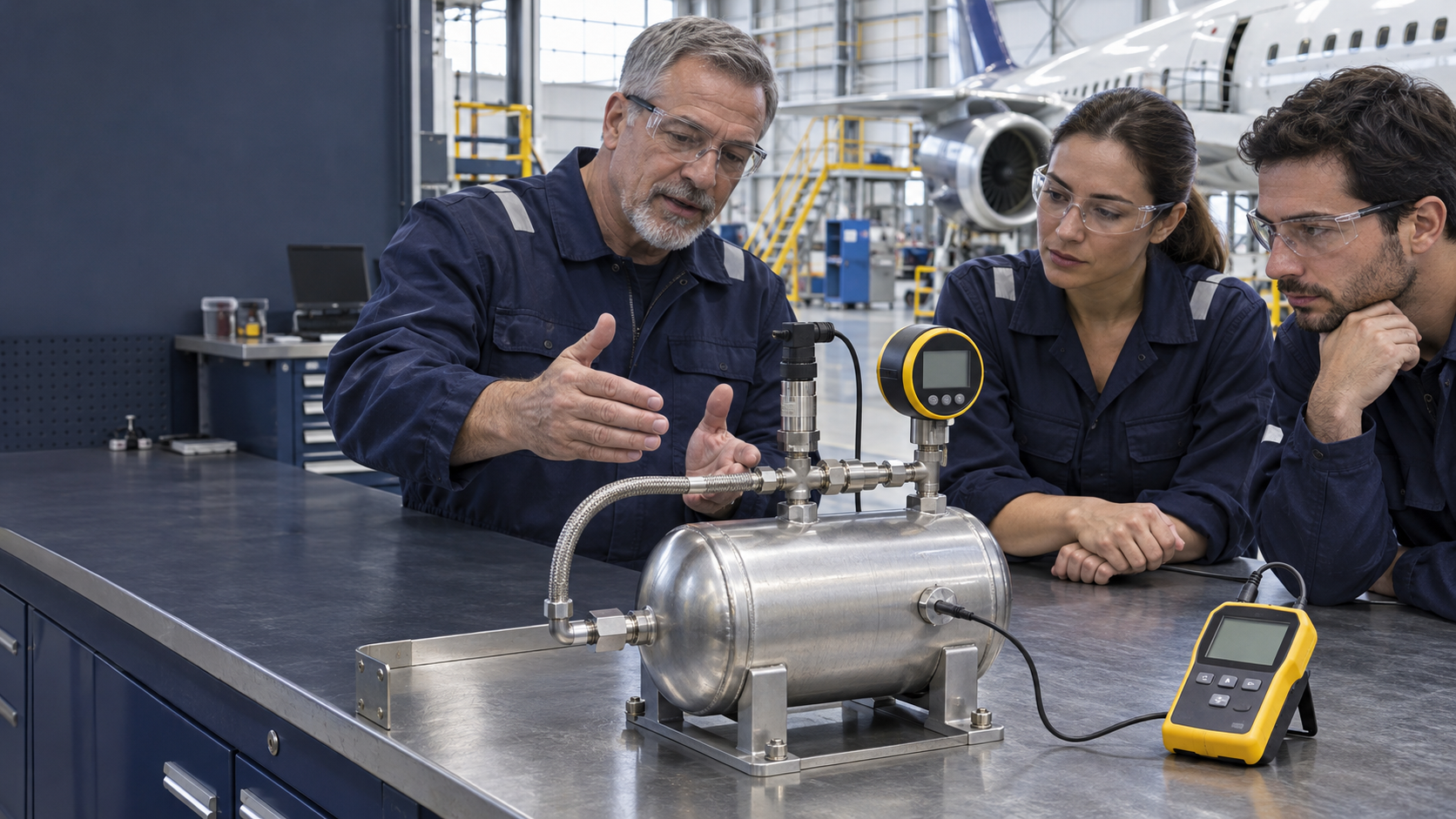
A pressure reading is easier to understand when you also consider temperature and the system’s condition. Use the same approach in your study: observe, understand, then check.
This example illustrates the learning method. Actual maintenance decisions use the applicable aircraft documentation.
Assume a fixed mass of ideal gas in a rigid vessel. How should we interpret a higher pressure reading?
Look beyond the pressure gauge.
Identify the pressure reference and temperature. Confirm the model: fixed mass, fixed volume, and comparable equilibrium states.
Connect the reading to the principle.
For this ideal-gas model, absolute pressure is proportional to absolute temperature. If the gas warms while mass and volume stay fixed, pressure rises.
Check the units and the assumptions.
Use kelvin temperature and absolute pressure in gas-law ratios. Ask whether mass or volume changed before applying the fixed-volume relationship.
Related study: Section 6 — Thermodynamics and Heat Transfer · Lesson 6.6 — Gas Laws and Thermodynamic Processes
English is the master edition. Arabic, Urdu and French lesson editions support understanding; visual labels and assessment questions remain in English.
Explore the curriculum and build your understanding lesson by lesson.